Grave of Wood Guardian Attack
Chasing SunlightGrave of Wood Guardian Attack is the decisive encounter in which the Endeavor escapes a pursuing cyclone only to confront the immense serpent that protects the cemetery. The event transforms a desperate act of sheltering into a lesson in the Grave of Wood’s absolute authority: tethering is apparently safe, but disrespect toward the dead provokes a force capable of swallowing a lightning-shot storm.
Flight Toward the Grave of Wood
The event begins with the Endeavor racing toward the Grave of Wood while the gale drives the vessel ahead of the vortex. Captain Montgomery pilots the ship toward the cemetery’s enormous funerary monuments as the storm shakes the entire frame. Orders pass continuously between the bridge and the crew, and the bos’n’s voice booms through the speaking-tube over the wind and creaking metal. The approach is therefore both tactical and interpretive: Jonathan Heights knows enough of the site’s rules to advise the crew, but not enough to offer certainty.
Jonathan warns that nothing may be taken from the Grave of Wood, perhaps not even the wood itself. He explains that merely tethering the Endeavor there should be safe, while admitting that his earlier visit was brief and hurried and that the rules governing such places had been learned only through difficult experience. His incomplete knowledge gives the shelter an unstable status. It is not a refuge granted by friendly inhabitants, but a narrow permission that the crew must avoid turning into trespass.
As the ship descends, the cemetery’s forms emerge from the storm: enormous, carved biers topped by crystalline figures whose faces are hidden beneath cloth. The scene offers no leisurely archaeological inspection. The Endeavor is too damaged or endangered to pause, and the crew can only register the solemn monuments while trying to survive the weather. When a bridge pane crazes and cracks, an airman pushes the broken glass outward before the wind can turn it into a weapon. Salt air and the dry, earthy smell of wood enter the bridge, but the place carries no living scent, making the cemetery feel sealed within its own dead order.
The Guardian’s Attack
The pilot cuts across the gale and drives the Endeavor into the lee of a bier broad and tall enough to shelter the vessel. The storm’s pounding is briefly muffled as airmen leap down with tethers, using zint devices to anchor them in the rocky ground. Other crew members hurry to cover exposed parts of the ship with cloth tarps and metal shutters. The apparent success of the maneuver creates a brief expectation that the Grave of Wood will function as a sanctuary.
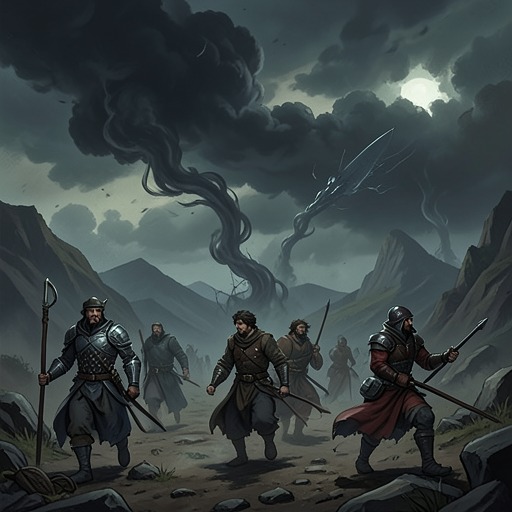
That expectation changes when a slow sliding sound announces a presence larger than the ship. A massive, sinuous silhouette rises above the graves like a great snake and strikes into the storm with blinding speed. The guardian is initially conveyed through shadow and scale rather than through a complete view, preserving the terror of an unseen or only partly seen power. The cemetery’s darkness and the storm’s illumination make the creature’s outline legible without making it comprehensible.
The wind’s groaning and howling becomes screaming as the guardian coils around the storm as though the cyclone were solid. In a reversal that exceeds the crew’s understanding, the immense titan consumes the lightning-shot storm, drawing its luminous threads into its obscured gullet. The wind, debris, and storm-noise die away over several minutes as the serpent swallows the entire cylinder. It then returns among the graves, appears for a moment to look toward the Endeavor, and disappears into the darkness between the biers. The attack is thus not an assault aimed at the crew but a territorial response directed at the storm, with the ship surviving because it has remained within the cemetery’s apparent limits.
Rules of the Cemetery
Eleanor McAvey immediately identifies the guardian’s presence as the reason the crew must proceed carefully. Jonathan confirms that the Grave of Wood is guarded and clarifies the apparent condition of its violence: from what he has observed, it reacts to disrespect toward the dead. The event therefore converts an obscure prohibition into demonstrated fact. Jonathan’s warning about taking objects is no longer merely scholarly caution; it is part of a living system of funerary protection.
Captain Montgomery asks whether the monuments contain actual bodies or are only tombs. Jonathan answers that he thinks they are both, while observing that their scale seems appropriate to the construction of the Arch of Khokorron and that they are clearly unrelated to the builders of Tor Ilek and Angkor Leng. The cemetery consequently becomes evidence of civilizations whose histories survive only in isolated remains. Yet the crew refuses investigation. Whatever archaeological value the biers possess, the guardian attack has established that curiosity cannot override the Grave of Wood’s prohibition on taking from the dead.
The scene’s central value shift is from shelter to conditional safety. The Grave of Wood saves the Endeavor from the cyclone, but it does not become domesticated by that rescue. Its protection is inseparable from its threat, and the guardian’s ability to consume the storm places the crew beneath a power that does not need to explain itself. Safety exists only through restraint.
Consequences and Narrative Significance
The guardian attack leaves the Endeavor alive but chastened. The crew can shelter behind a bier and tether to the cemetery’s ground, yet the encounter denies them possession of the place. The distinction between using a refuge and claiming it becomes crucial: the Endeavor may pass through or remain temporarily, but the dead and their monuments are not resources for exploration or repair.
Narratively, the event enlarges the world’s ancient sites from inert ruins into environments governed by particular laws. The crystalline figures, shrouded faces, oversized biers, and missing historical connections already suggest a civilization beyond ordinary historical recovery; the serpent makes that buried past active. It also gives material force to the Grave of Wood prohibition on taking from the dead, while contrasting human machinery with a guardian that treats a cyclone as something edible. The crew’s engines, tethers, tarps, shutters, and speaking-tube represent organized improvisation, but none of them explains or controls the cemetery’s defender.
The event’s horror develops through gradation. First comes anticipation: the ship flees the vortex and struggles toward shelter. Then comes recognition of the silhouette, followed by the more terrible revelation that the guardian can coil around and consume the storm itself. The final glance toward the Endeavor is quieter but no less significant, because it leaves the crew uncertain whether they have merely been tolerated. The Grave of Wood is not made safe by the guardian’s intervention; it is shown to be safe only so long as the living remember that they are guests among the dead.